Saturday, 29 May 2021

PETA - Do you know Indian Culture?

Tamilians of South India Hats off to you.

You understood very early that objective of PETA (People for the Ethical Treatment of Animals) was not protecting animals, but killing Tamil culture (Jallikattu).

PETA attacked Indian culture this time by suggesting Amul (largest dairy in India ) to switch to Vegan Milk.

What was the basis of suggestion?

PETA in its letter to Sodhi cited a 2018 report by global food corporation Cargill which claims that demand for dairy products around the world is on the decline as dairy is no longer considered an essential part of a diet.

Questions to PETA?

  • Is Cargill, Nestle and other food giants one of key donors to PETA? If Yes, please state the figures.
  • As Mr. Sodhi of Amul India stated “Will they give livelihood to 100 million dairy farmers (70% landless)? Who will pay for their children's school fees? How many can afford expensive lab manufactured factory food made out of chemicals and synthetic vitamins?”
  • PETA India Head, you did some thinking / research on Indian culture / employment/ economy or just forwarded the suggestion came from PETA USA without thinking?
  • Why now PETA suggested this idea of vegan milk during a period when Indians are fighting COVID battle? Is this a conspiracy by the PETA USA?
  • During the COVID attack who would have benefitted more from VEGAN Milk? I will list it:
    • The so-called VEGAN promoting global food giants like Cargill and others?
    • Shareholders of the global food giants?
    • Stakeholders of the global food giants like Soya, Almond, Nuts producers?
  • Will PETA tell which is the most common product used for VEGAN milk? Answer: Soya, Almond, Cashew, Oat (top 4).
  • Who are the major producers of Soya, Almond, Cashew, Oat?
    • Soya – USA , Brazil, Argentina
    • Almond -USA, Spain, IRAN
    • Cashew – Vietnam, India, Côte d'Ivoire
    • Oat – Russia Federation, Canada and Poland
  • Most important question : are you promoting USA and want to benefit few large corporations by starving millions of Indians?
  • It appears PETA cares more about Animals, select countries and their giant food corporations than an ordinary Indian who survives with bare minimum needs?
On Top dairy free milk brands:

Here are the world’s top dairy-free milk brands.

USA/Canada
Blue Diamond Almond Breeze
Edensoy
Oatly (Oat drink, chai, latte, and Barista Edition)
Pacific Non Dairy Beverages (Soy, Almond, and Coconut Varieties)
Ripple Dairy-Free (Pea-Based)
Silk (Soy, Nut, Almond, Oat “Oat Yeah”, and Coconut Varieties)
So Delicious Dairy-Free (Almond, Cashew, and Coconut Varieties)
Trader Joe’s (Soy, Almond, and Coconut Varieties)
WestSoy
Zen Soy
Whole Foods Market 365 Everyday Value (Soy and Almond Varieties)
Australia/New Zealand
Nutty Bruce
Japan
Here’s a terrific page listing all major brands of soy milk sold in Japan, including package photos for each. And here are four top brands that you can find in nearly every grocery:
Sujahta
Fukuren
Midori
Kikkoman

I support Tamilians of South India for being proactive and suggesting ban over PETA.

What Tamilians of South India understood in 2017, North-East-West of Indians are yet to understand i.e. PETA wants to destroy Indian culture.

Sunday, 2 May 2021

Aditi Mutatkar - Wonderful Interview

Interview of Aditi Mutatkar in Indian Express (former Number 1 Indian badminton player) threw out many statements which a honest sports person undergoes and feels.

Some statements are reflections which come out after you have left the sport and start reconciling with life. Thanks to Aditi for sharing her part of story which was a very inspiring one.

Enjoyed reading thoughtful statements from Aditi.

Every sports person should read this interview and learn from the journey.

Key statements which is worth sharing is listed below:

Memories of a sportsman

“Look, me and Saina will always be a painful memory for me. She was extra-ordinary. I wasn’t extra-ordinary. It is not easy to accept that someone is so good that you don’t have a chance at all. I could never break through that aura of Saina,” 

Mistakes ignorantly committed have important learning

On her return from Europe, a writer from Bangalore would urge Aditi to scribble about her fruitful European sojourn. “I actually wrote a nice piece titled ‘Thank you, Saina!’ It was written in the spirit of ‘You raised the bar, so we could follow.’ Day after, Tom sir (coach Tom John) was looking at me funny and asked me in his typical way: “Are you an idiot? What have you written? Don’t treat her like a god.'”

Very important message

Aditi jokes she can serve as a giant WARNING sign to the next generation, now chasing PV Sindhu, an even bigger figure. “Never put them on a pedestal if you have to play them! Have respect for them, but don’t be satisfied with just nicking a few points off them. On the court, you have to start as equal. They shouldn’t be beating you in the head even before the game has begun.”

Feelings on what was missing in coaching and attitude 

Badminton’s famous clash of cultures between Bangalore and Hyderabad, didn’t help matters. “Prakash sir and Vimal sir had a very democratic setup. Noone received special attention, and it was like sabko saath leke chalo. (Take everyone along). I had my Pune middle class attitude which could only take me to a certain level. At the top level, you need to be extremely selfish, doesn’t matter who falls by the wayside,” she explains.

Difficulty to reconcile and then to settle down

“I was competitive. But how do I accept that she’s 10 times better than me. Not knowing how to deal with it even when I played against her, ate me up,” she recalls of a torrid time.

At 15, Aditi had looked at her achievements the way other people saw them: casually tossing them aside compared to Saina’s. “I saw myself the way Saina saw me. But I should’ve enjoyed the journey more, rather than being caught up in this,” she says.

Dawn of wisdom

“I learnt that we should enjoy what we’re doing and not let another athlete bog you down. Sport is cruel, there’s no place to hide. But you can’t say, what’s the big deal in No. 2. Atleast you are No 2! When I won titles it was always back of my mind that she’s not there. But there were other challengers. And I beat them all. It really wasn’t as bad as I thought.”

We lionise winners, but there’s no space for ordinary champions or runners-up. In my life, every opponent gave me something to learn from, and were important in my journey,” 

Interview Link :(Indian Express) Aditi Mutatkar

Reflections of a self

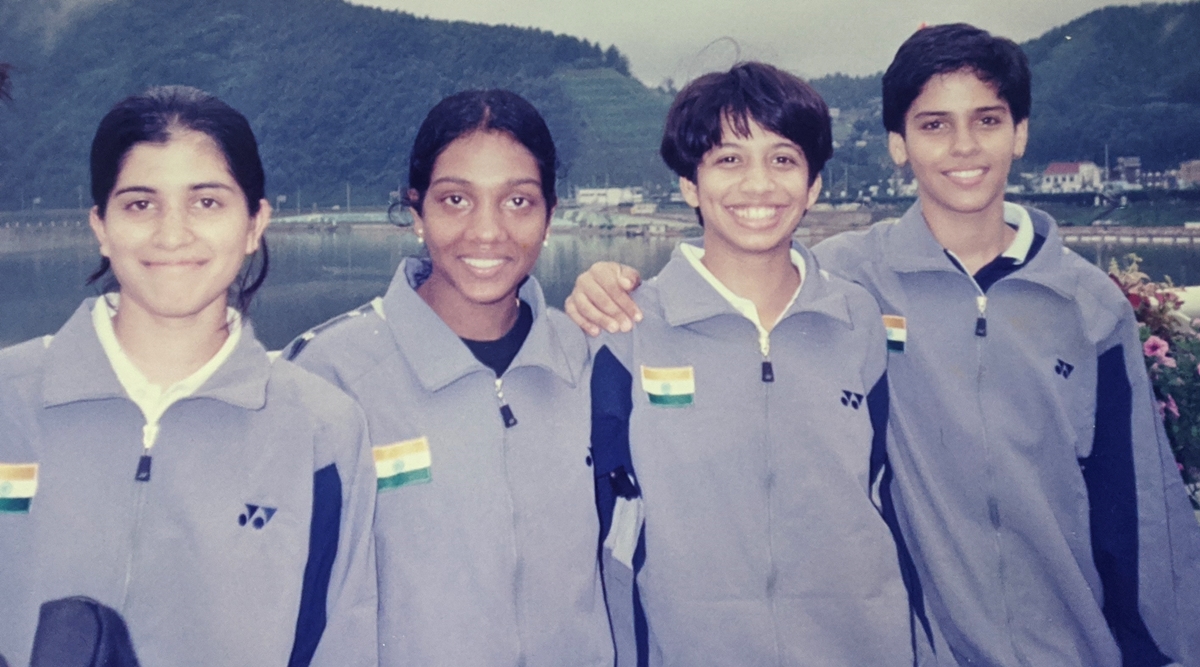
In the below photo (from the Indian Express article) anyone from the four would have been a world champion with only change in name and face. We have to accept we know nothing about future and how life progresses.

We may never know who the other two in the photos are, may be they have some stories to share about their journey too.


Wednesday, 14 April 2021

The Absurdity of Politics

An interview of Joseph Heller on Absurdity of Politics is worth reading. Heller (Catch 22 Author) discussed about Democracy and other related issues about President / Government.

The interview is must read as many illuminating ideas are shared by Heller.

Highly recommended to read.

Joseph Heller: The Absurdity of Politics

Select portions from the interview for nudging the readers to read:

Well, it’s disgusting to realize that there are organizations and specialists who exist in grooming and advising a candidate for office, whether it’s a mayoral or gubernatorial election, or a federal election. They tell him what to wear, how to stand, where to sit, what to say. But isn’t it equally disgusting that we know about it, and we’re not revolted by that?

Well, after doing this novel, Picture This, where I studied history, I’ve come to the conclusion that men don’t make history. I think. history makes personalities. It’s only Shakespeare, “There is a tide in the affairs of men-”

No, I didn’t find it at all. In fact, I found as democracy was instituted, it be-came more chaotic, more chaotic, more corrupt, more warlike. Another thing I learned from Athenian history and it’s corroborated by our own is, it is much easier for the leader of a country to make war than to administer to the domestic problems of that society.

That statement was made by Plato at about 380 B.C., in The Republic. “All societies we know of are governed by the selfish interests of the ruling class.” Can you think of many societies between Plato’s Athens and today to whom that would not apply in very large part?

No, I think that if you look at the history of monarchies, you would find the exceptional king, the accident of birth and circumstance was a blessing, but they appeared intermittently. There’s no system I can envision that would elevate to office the kind of people that we would like to see elevated.

Source: R. Balakrishnan

Friday, 9 April 2021

Blood Money

Blood Money definition:

money paid to someone for killing someone else, or for giving information about a person who has killed someone

Italian marines had killed two Kerala fishermen in the year 2012.

Settlement method:

SG: Indians are the best negotiators and we have negotiated a good deal. They have paid 10 crores more. Victims have accepted it now

SG: Italian embassy responded it agreed on the compensation of ₹ 10 crores to be paid as total compensation under all heads. Govt of Kerala in letter dated Nov, 2020, stated that victims would recieve 4 crores and other to the boat owners.

SG - Solicitor General of India.

Unfortunate but true. World has not changed.

Source:

Tuesday, 16 March 2021

Takeaways - Financial Fiasco by J Norberg

I have read four / five books on 2008 credit collapse / Lehman crisis. I was wondering what Financial Fiasco by Johan Norberg, will offer. Initially after 10 to 15 pages, thought of leaving the book developed. Suddenly a passage appeared and I was blown away.

This book is worth reading to understand how the Governments, Regulators, Bankers, Credit rating agencies and public in large were responsible for the credit crisis.

Takeaways from the book is listed below:

A Shocking Truth

The toxic seed called non-recourse mortgage.

A specifically American phenomenon contributed to making so many potential buyers willing to take a chance. In many parts of the United States, there exists something called a ‘‘nonrecourse mortgage,’’ meaning that a home loan is linked to the home, not to the person who has taken it out. The home is collateral for the loan, and the home is the only thing that the lender can get back if the borrower decides to stop paying. People can thus buy houses that they cannot really afford on the assumption that they will be able to negotiate a better deal on interest rates later (lenders are often willing to lower the rate rather than risk having to take over the house) or that prices will rise so that they can sell at a profit. In most countries, homebuyers who stopped paying their loans would be saddled with a mountain of debt; but in about half of the U.S. states, buyers can return the keys to the bank and walk away debtfree. As it also became increasingly common that households did not even have to put down a deposit, they stood to lose nothing at all by taking a wild gamble. In some states with nonrecourse mortgages, including California, lenders do have a theoretical possibility of going to court and requesting more money from a defaulting borrower if the selling price does not cover the loan, but this is a long and costly process that is typically used against borrowers who have large assets.

Culprit for Low Interest Rates

If there is one person responsible for the low interest rate it is Alan Greenspan.

Alan Greenspan is Jack Welch.

In December Mr Greenspan was made a Freeman of the City of London. One of the traditional perks of this honour is that he can be drunk and disorderly without fear of arrest. The snag is that his policies have also encouraged drunk and disorderly asset markets and intoxicated consumers. When the party ends, Mr Greenspan will not be there to clean up the mess. But end it surely will.

Perils of printing money

The printing press may look less intimidating than the taxman, but in practice it is worse. Creating more money not only entails an indirect tax in that it reduces the value of citizens’ savings but also, and more importantly, undermines the price system by giving businesses incorrect information about demand. The additional money created does not end up everywhere at the same time but percolates into the economy in certain places, where it leads to price increases, which businesses interpret as an increase in demand, causing them to hire more people and step up production. Only after a while do businesses realize that the prices of everything else have also risen and that their costs are increasing even though they are not selling any more than their competitors. In fact, the price increase did not indicate an increase in demand, only a deterioration in the value of money. As a consequence of these incorrect market messages, resources have thus been brought to places where they should not have ended up, meaning that the businesses now have to cut down on production and lay off people.

Problem with American Capitalism

In the debate about how Fannie and Freddie inflated the housing bubble, the right has claimed that they were government corporations, whereas the left has argued that they were private businesses. But as we have seen, they were in fact an entirely different animal— a hybrid of public and private. The technical name for the hybrid that they represent is government-sponsored enterprise (GSE). A GSE is potentially the most dangerous type of enterprise since it may allow private owners to take any risks they can imagine, pocket any profits for themselves, but count on taxpayers to take care of any losses. Fannie and Freddie have been privately owned, but with a political mission and with an implicit federal guarantee in case they should fail. That guarantee has made their business concept a lucrative one.

Noble Laureate – Not better than us

In 2002, Fannie paid the Nobel laureate Joseph Stiglitz, the future federal budget director Peter Orszag, and economist Jonathan Orszag to conduct a study that found that there was ‘‘extremely low probability’’ that Fannie and Freddie would become insolvent. The study talked about scenarios with a likelihood of one in more than 500,000 and claimed that the risk to the government was ‘‘effectively zero.’

As late as July 2008, Paul Krugman, a leftwing economist who would soon win the Nobel Prize, attacked the critics of Fannie and Freddie, pointing out that the duo had nothing to do with risky lending and had not made a single subprime loan.43 Krugman may have been mixing things up: It is true that Fannie and Freddie did not lend to subprime borrowers, because they did not lend at all; but they did buy loans, and a growing share of those loans were subprime.

Central Bank

Central Bank is referred to us lender of last resort. One of the reason is explained well:

The bank has the capital, but it lacks liquidity.

Above happens when there is run on the banks.

Disaster created by CDO

If a household runs into trouble in a state that allows borrowers to return the keys to the bank and walk away, the mortgage is usually renegotiated. It is better for the bank to have someone living in the house, who may be able to pay back the loan in the longer term, than to be forced to take over the house and try to sell it just when prices are lowest. But the securitization of mortgages had led to an unexpected consequence: The original lender no longer owned the loan, because it had been repackaged and sold and then chopped up and sold as part of a collateralized-debt obligation. Households in default no longer had an individual lender to negotiate with, which made more and more of them just abandon their homes and either buy something cheaper or start renting.

The CEO’s ignorance with fat pay

Citigroup’s Charles Prince (the man who stood accused of being unable to tell a CDO from a shopping list) found out for the first time at a board meeting in September 2007 that his bank was sitting on $43 billion in various types of mortgage-backed securities. He asked the person responsible whether this was a problem and was told that no major losses could be expected. Only two months later, however, the bank estimated its subprime losses at $10 billion. Prince chose to step down—taking $38 million in bonuses, stocks, and options with him.


UK and how it misused legislation

The British government also froze Landsbanki’s assets in the United Kingdom. The method it chose probably set a world record for abuse of legislation. It applied an anti-terrorism law enacted in 2001 that was designed to freeze the assets of foreigners planning to damage the United Kingdom or its economy. Icelanders, whose country habitually tops international rankings of freedom, democracy, and noncorruption, could suddenly visit the website of Her Majesty’s government and find themselves listed alongside terrorists and rogue states: al Qaeda, the Taliban, North Korea, Iran. . . . And as if this was not enough, Prime Minister Gordon Brown also mistakenly said that the British government would freeze any Icelandic assets it could lay its hands on and demanded that Iceland compensate British savers in a way that would slap a burden of debt per capita on it, not dissimilar to that imposed on Germany at Versailles.

Blackmailing the US President by Economist

Paulson and Bernanke had secured support for their proposal earlier that day in the Roosevelt Room, a classic meeting room in the West Wing of the White House with no windows but fake daylight coming from a false skylight. This meeting, in the words of one of those present, ‘‘scared the hell out of everybody.’’ The Treasury secretary and the Fed chairman had told President Bush about the panic in the credit markets, explaining that if he did not sign off on the biggest bailout in history, the United States would be hit by a crisis bigger than the Great Depression. The president had been speechless, almost stunned, for a moment. Then he had sprung into action.

How Banks preached but not practised

When 21 banks that had received at least $1 billion each of taxpayers’ money were asked by the Associated Press what they had done with that money that they otherwise would not have done, not a single bank gave a straight answer. Several said they did not know. The Morgan Stanley representative would reveal this only if she could remain anonymous, and the person from New York Mellon Corp. replied, ‘‘I just would prefer if you wouldn’t say that we’re not going to discuss those details.’’ It is not a wild guess that the banks themselves would never grant a loan to someone who came strolling into one of their branches and gave that answer to the question of what he or she intended to do with the money.

Saturday, 6 February 2021

Gamestop Saga

 Gamestop Saga is an eye opening event in the history of share trading.

Below podcast is worth listening and knowing what happened , what are the repercussions etc.


Source: Jana V

Monday, 1 February 2021

Flash Crash - Takeaways

Flash Crash book by Liam Vaughan. 

The book is worth reading and understanding the world of Trading / Genius of Navinder Singh/World of regulators.

The book is fast paced and worth undertaking journey of Navinder with Liam.

Takeaways from the book:

  • One man and One Machine can bring down world financial markets in one hour
  • What happens in market real time is unknown to any one including regulators
  • Trading is better left to machines as individuals will only lose
  • If an independent Trader does it is crime and gets convicted, if an institution does it is a mistake and system need to be rectified
  • By nature, futures and options invite speculation amongst traders
  • The faster you earn money the more time you should rest
  • Let money be earned at a fixed rate the regulators and world does not notice it
  • Always keep a hard assets like Gold , Silver or Real estate as an alternative wealth for paper money
  • The myth of liquidity provided by HFT was thrown out of window
  • Don’t blame SEBI / RBI / Other regulatory bodies in India. Even SEC USA has same problems.
  • To learn what not to do:

    1. Let not greed overtake as a trader easy money is pocketed
    2. Learn to stop take rest and enjoy the easy money pocketed
    3. Even if easy money is flowing in you never know how it will backfire

Problem of Governments / Regulatory bodies were rightly presented in the below line

In response to the clamor, the government did what it often does and formed a committee—the Joint CFTC/SEC Advisory Committee on Emerging Regulation—comprising industry leaders, former regulators, and Nobel Prize–winning professors. Its mandate was to consider what, if any, changes should be made to the structure and oversight of the markets in this brave new automated world. It was an illustrious group, but none had any direct experience with high-frequency trading. The youngest member was fifty-five.

A serious problem in Markets

For them, spoofing is a hindrance, and after the introduction of the disruptive trading rules, firms such as Citadel and HTG Capital Partners would go on to work closely with regulators to identify and prosecute parties whose unpredictable trading disrupted the smooth functioning of their moneymaking machines. In a number of cases they appeared as witnesses for the government. “Imagine a system where the biggest, most powerful players get to tell the regulators and the exchanges who to go after based on who is taking money off them,” says one prop trader. “Welcome to the futures market.”